Sales Activity vs. Sales Productivity
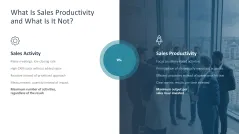
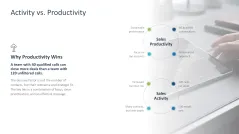
Sales activity shows how much is happening in sales. Sales productivity shows what really generates revenue. Lots of calls, meetings, and quotes may seem dynamic, but they don't automatically lead to more deals. When time is spent on internal coordination, reporting, or weak leads, activity increases, but so does inefficiency. Sales productivity shifts the focus from activity to results. The decisive factors are which steps advance deals, which customers have priority, and where processes can be simplified. Less idle time, more clarity, more revenue per hour.
Non-Selling Tasks as Invisible Productivity Killers
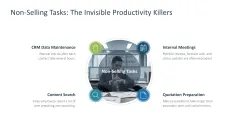
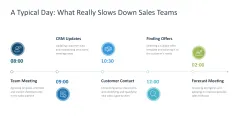
Non-selling tasks are the silent time wasters in sales. CRM maintenance, reporting, internal coordination, quote formatting, and data post-processing seem necessary, but they do not generate direct revenue. They add up to hours that are missing for customer meetings, needs analysis, and closing deals. These tasks often remain invisible because they are part of everyday life. However, they drastically reduce the amount of time available for sales. If you want to increase sales productivity, you need to make these activities transparent, simplify them consistently, and automate them where possible.
Sales Productivity for More Efficient Sales Processes
Sales productivity creates the basis for more efficient sales processes. Instead of simply continuing with established procedures, process steps are critically reviewed, clearly structured, and consistently aligned with closing relevance. Duplication of work, unnecessary coordination, and manual routines are reduced or automated. At the same time, digital tools and AI ensure transparency in the pipeline, prioritize opportunities, and support the next meaningful action. The result is a sales system that minimizes friction losses, uses resources in a targeted manner, and enables measurably higher sales per hour.
Everything About Sales Productivity in a PowerPoint Template
Our new PowerPoint template bundles all the key aspects of sales productivity into a clearly structured overall concept. It shows the difference between activity and actual impact, reveals non-selling tasks as hidden productivity killers, and provides approaches for optimizing processes, pipelines, and prioritization. It also explains how automation and AI can reclaim sales time and direct it toward value-adding steps. The result is a practical guide that helps sales teams achieve more results per hour worked.
With This PowerPoint Template You Can …
- present what sales productivity really means.
- make time wasters and non-selling tasks in sales transparent.
- develop a basis for more efficient sales processes.
This PowerPoint Template Includes:
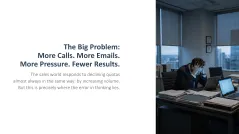
- The big problem
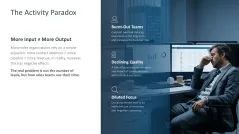
- The activity paradox
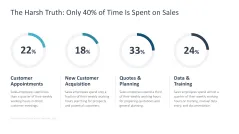
- Only 40% of time is spent on sales
- Non-selling tasks: The invisible productivity killers
- A typical day: What really slows down sales teams
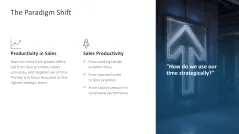
- The paradigm shift
- What is sales productivity and what is it not?
- Activity vs. productivity
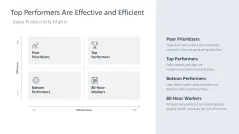
- Top performers are effective and efficient
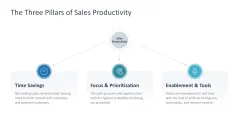
- The three pillars of sales productivity
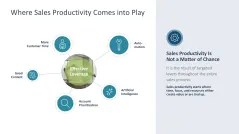
- Where sales productivity comes into play
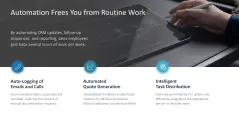
- Automation frees you from routine work
- Artificial intelligence as an intelligent sales assistant
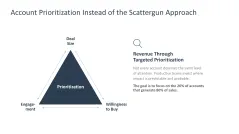
- Account prioritization instead of the scattergun approach
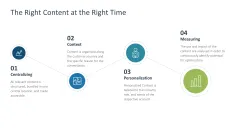
- The right content at the right time
- What ""less admin time, more customer time"" means
- How to get started
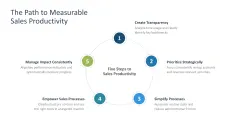
- The path to measurable sales productivity
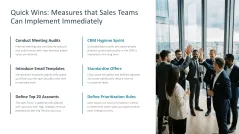
- Quick wins: Measures that sales teams can implement immediately
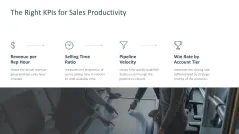
- The right KPIs for sales productivity
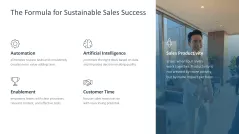
- The formula for sustainable sales success
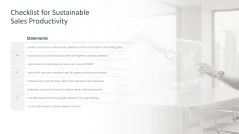
- Checklist for sustainable sales productivity
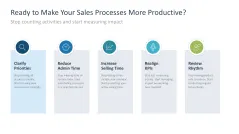
- Ready to make your sales processes more productive?