What Makes a Successful Startup?
A successful startup is defined by more than just an innovative idea. It requires a clear vision that serves as a compass for the founders, a strong and motivated team, and the ability to react quickly to market changes. Successful startups know how to continuously adapt and validate their business models, whether through Lean methods or by gathering customer feedback. Furthermore, a solid financial strategy, the right financing, and a targeted growth strategy are crucial for long-term market survival and scaling. A startup’s success is based on a combination of innovation, flexibility, and a clear, forward-looking focus.
What Does an Effective Startup Strategy Look Like?
An effective startup strategy is based on a clear vision and a systematic approach that covers all key business areas. At the outset, it is essential to develop and validate a solid business model to ensure that the idea meets market needs. An effective strategy uses the Lean methodology to iterate quickly and identify risks early on. It is also crucial to build a strong founding team that collectively drives the vision forward and responds flexibly to challenges. The strategy should encompass both short-term goals, such as product development, and long-term growth and scaling strategies. Financial resilience, the right financing, and clear market positioning are also essential for ensuring the startup’s long-term success.
What Role Does the Founder’s Personality Play?
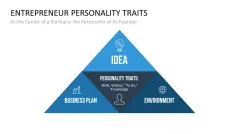
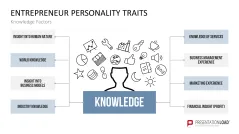
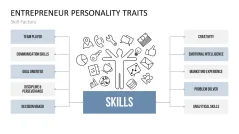
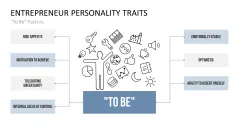
The founder’s personality plays a decisive role in a startup’s success. It not only shapes the company’s vision and values but also influences the corporate culture and the way challenges are overcome. Founders must possess strong leadership skills to inspire their team and make the right decisions, even in uncertain times. Their ability to take risks, remain flexible, and continuously evolve can make the difference between success and failure. Additionally, a founder’s personality is often the face of the startup, building trust with investors, customers, and partners. A clear vision, high resilience, and the commitment to lead the company to long-term success are essential qualities that ensure a startup’s growth and stability.
Everything About the Startup Strategy in a PowerPoint Template
Our PowerPoint template provides you with a structured and practical overview of all key aspects of a startup strategy. It shows you how to develop a clear vision, build the right founding team and a strong team, and use the Lean methodology strategically to validate your ideas. You will learn how to efficiently create and visualize your business model, formulate a growth strategy, and successfully scale your startup. Financial resilience and the right financing are also highlighted as crucial steps to secure your startup’s long-term future. By systematically applying these strategies and processes, you lay the foundation for sustainable success and make your startup strategy understandable, immediately actionable, and measurably effective for your company’s success.
With This PowerPoint Template You Can …
- develop your own startup strategy step by step.
- present what makes a successful startup strategy.
- visualize your startup strategy using modern PowerPoint slides.
This PowerPoint Template Includes:
- Rapid scaling over stability
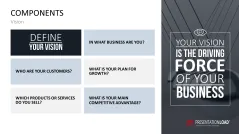
- Vision, mission & values: your north star for decision-making
- Your success definition
- Founder traits: personality matters
- The six founder types of the FOALED model
- The dream team: hackers, hustlers & hipsters
- Why diverse teams win
- Who takes on which roles?
- Culture and values as the invisible foundation
- Future recruiting: hiring people who grow with the company
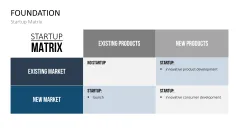
- Four ways to enter the market
- IP strategy: protection through patents
- Disruption: taking on the big players
- Value chain: positioning yourself as an indispensable partner
- Architecture strategy: innovative ideas
- Blue ocean strategy: making competition irrelevant
- Unique selling proposition: what makes you truly unique?
- Market validation: a reality check
- Lean startup principles: customer feedback vs. intuition
- Mastering the lean startup cycle
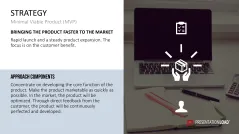
- Minimum viable product (MVP): maximum learning with minimum effort
- Pivot or persevere?
- Find the metrics that really matter
- Making better decisions with A/B testing
- Regular feedback as the engine for better results
- Validation before scaling up: no proof, no growth
- Business model canvas (BMC): the nine building blocks of your success
- Understanding the value proposition and customer segments
- Success comes from strong partners and clear actions
- Lean canvas: the startup-optimized business model
- Which model is right for your situation?
- Canvas workshop
- What does scaling mean?
- Four ways to accelerate growth
- When are you ready to scale up?
- Automation and outsourcing as growth drivers
- How to master revenue optimization
- Agility in growth: agile despite size
- Managing performance with Objectives & Key Results
- Guiding startups through all stages of financing
- Levering the right funding sources for growth
- Control through self-financing
- Go-to-market: finding early adopters and generating hype
- Why startups often fail
- Identify, assess, and effectively manage risks early on
- The blueprint is in your hands